Self-help
How to use a feelings wheel when you don’t know what you feel
Find a word that fits, try it against three everyday situations, and turn it into a short mood journal entry.

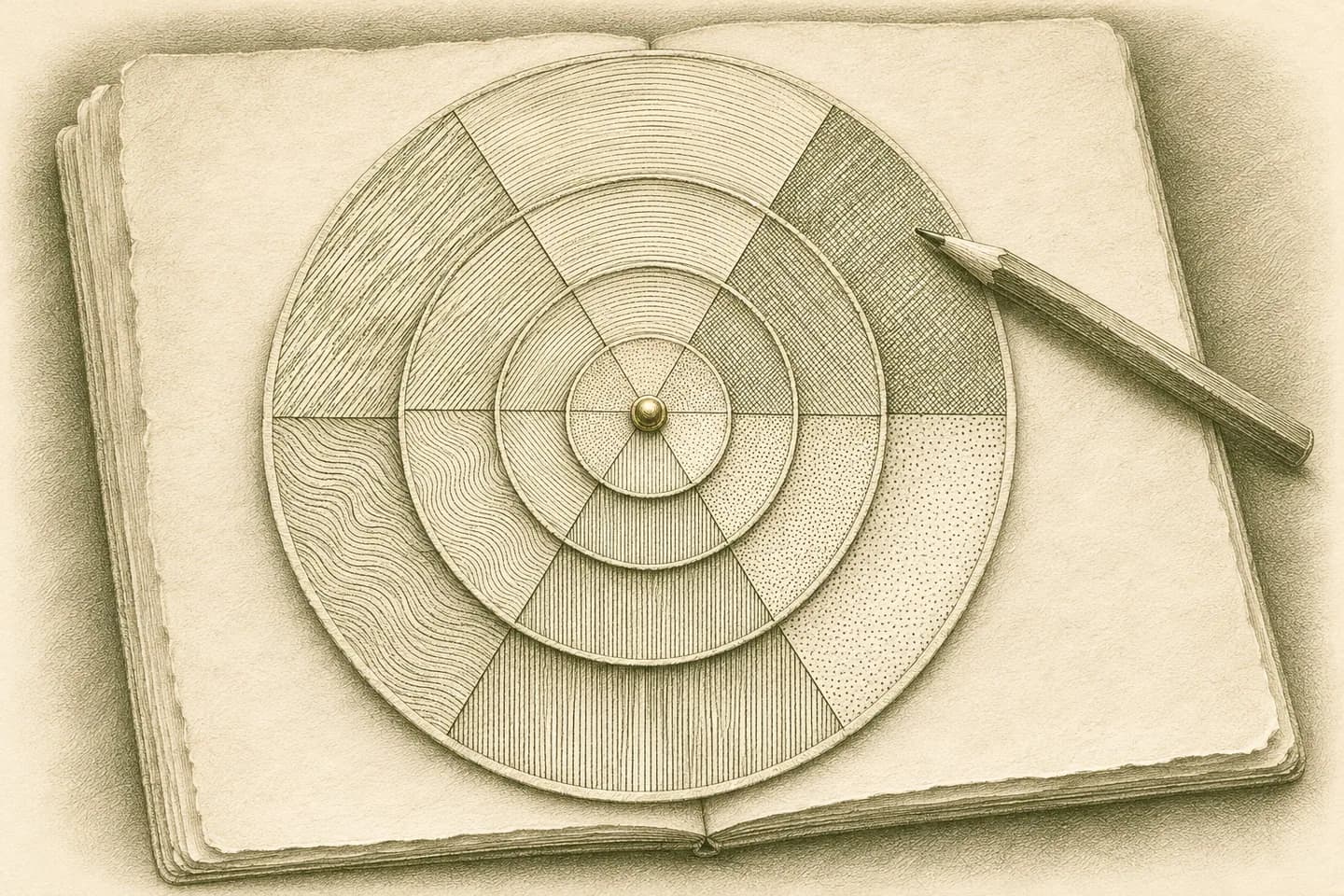
A friend cancels dinner as you are putting on your coat. You open your journal and write, “I feel bad.” Bad about what? You might have been looking forward to their company. You might also be relieved to have the evening to yourself. A feelings wheel gives you a few words to try against what actually happened.
Start in the middle
Choose one moment you can picture. Pick the word in the inner ring that comes closest, then read the two words in its outer section. Say each one in a sentence: “When I saw the message, I felt …” You can keep two words, move to another section, or supply a word of your own.
Read the words as a list
- Joy
- delight, gratitude
- Sadness
- longing, disappointment
- Anger
- irritation, indignation
- Fear
- unease, alarm
- Surprise
- amazement, bewilderment
- Calm
- relief, contentment
This small wheel is a vocabulary aid. The words around the edge are suggestions, and several feelings can fit the same experience. The University of New Hampshire counselling service also describes how to work outwards from a broad feeling to a more specific one.
Three everyday examples
A friend cancels at the last minute
If you had been looking forward to seeing them all week, try disappointed. If you rearranged your afternoon and they barely acknowledged it, irritated might fit. If a quiet night suddenly sounds wonderful, try relieved. Which word would you use if you told a friend about your evening?
Your manager sends “Can we talk tomorrow?”
“I’ve done something wrong” is your guess about the message. For the feeling, you might write, “I feel uneasy because I don't know what the meeting is about.” You can record that even if the reason for the meeting is still a mystery.
A friend gets the job you wanted
You smile when they call and feel low later. Your entry can hold both reactions: “I'm glad for them, and I'm disappointed that I didn't get the job.” You don't have to decide which feeling counts more.
What if nothing fits?
Write down what you noticed first: a tight jaw, an urge to leave the room, a smile that lingered. Then ask, “What was I hoping would happen?” Sometimes “I can’t tell yet” is the most accurate entry you can make today.
Make one journal entry
Try “When ___ happened, I felt ___ because ___ mattered to me.” For example, “When dinner was cancelled, I felt disappointed because I had been missing my friend.” If you want a next step, keep it small: “I'll suggest another date.”
See a filled-in mood journal and printable worksheet or explore the mood journal in the app.
If this topic resonates with you, you don't have to handle it alone.
👉 Try MentavitaAI psychologist helps you:
- - structure your thoughts
- - reduce anxiety
- - better understand your current state
Start with a short conversation — it takes just 2 minutes.
Disclaimer
Mentavita blog articles are for information only and do not replace an in-person consultation with a doctor, psychiatrist or licensed psychologist. If you have severe symptoms or thoughts of self-harm or suicide, seek emergency help immediately.